Property Sales → Deals → a deal → Money, and Payments Available
A property sale uses the same invoices, receipts and general ledger as the rest of Nyumba Zetu. Each deal has one sale contract from the moment it is reserved. Every bill and every receipt for the sale belongs to that contract, so the sale's account is always one place.
The payment plan
The plan is set when the offer is made. See Reservations, offers and the deal lifecycle.
| Line | Kind | Typically |
|---|---|---|
| Reservation fee | Fee | Paid at reservation. |
| Deposit | Deposit | Due soon after the offer. Fee plus deposit is often 10% of the price. |
| Instalments | Instalment | Dated payments while the home is built. |
| Balance | Balance | The last payment, often from a lender. |
- Fee plus instalments equals the agreed price, to the cent.
- Buyer or lender. Each line names who pays. A lender line is billed to the lender, on the same contract.
- Versions. A plan is never edited. Change plan writes a new version; lines already invoiced carry over as they were.
When bills are raised
| Bill | Raised | Due |
|---|---|---|
| Reservation fee | At once, when the unit is reserved | The same day |
| Each instalment | By the daily invoicing job, on its due date, or the agreed number of days before it | Its due date |
| Forfeit | When a sale is cancelled | The day of cancellation |
Sale bills are raised only by Property Sales. They cannot be made by hand from an invoice screen, and no instalment is invoiced twice. Bills are numbered INV- like any other invoice. The daily job does not send the buyer a message when it raises an instalment.
How a buyer pays
Every sale has its own payment reference: P followed by the contract number, for example P900002150. Give it to the buyer, and to any lender, to use as the account number.
| Route | How it reaches the sale | Status |
|---|---|---|
| Record payment on the deal | Staff record a receipt on the sale contract and apply it to the bills. Needs permission to create payments. | Available |
| M-Pesa paybill or bank feed | The buyer pays with the P reference as the account. With automatic reconciliation on for the branch, the payment is matched to the sale and applied. | Available |
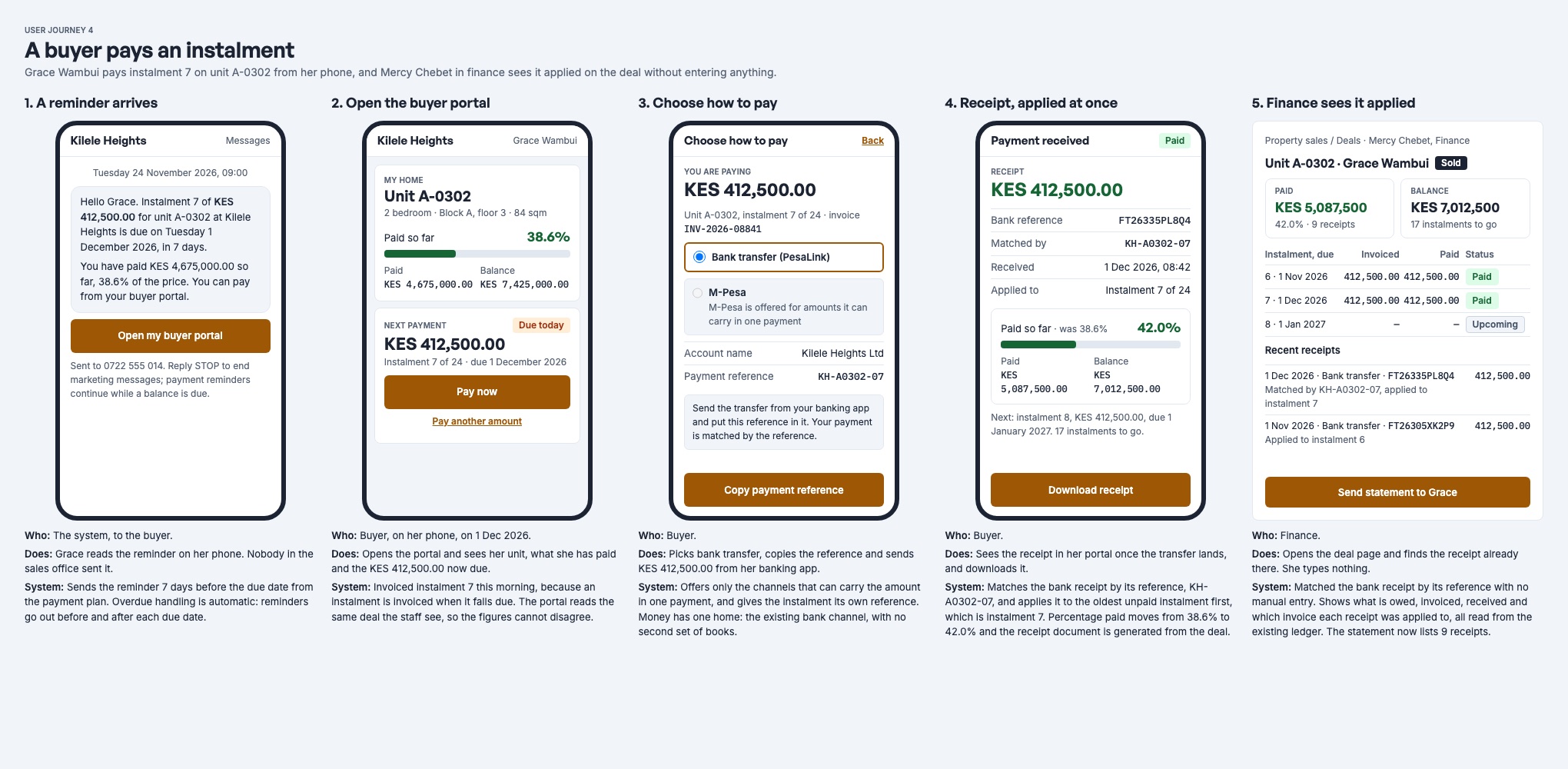
| Buyer portal Pay | The buyer asks for an M-Pesa prompt on their phone for a bill. | Available |
Receipts are numbered RCPT-. However the money arrives, it is recorded the same way:
- The receipt puts the cash in the bank and holds it as unapplied.
- Applying it pays the sale's bills, oldest first.
Overpayment. If a buyer pays more than is due, the excess stays on the receipt as credit in Unapplied receipts (2240). It is not counted as paid until it is applied to a bill. Finance can also refund it from Payments.
What money moves on a deal
Payments drive the deal forward. Nobody ticks these by hand:
| Fact | True when | What it unlocks |
|---|---|---|
| Payment received | Any money is applied to the sale | The deal can no longer lapse or be released. Ending it needs Cancel sale. |
| Deposit paid | The fee and every deposit line are invoiced and paid in full | With a signed agreement, the deal becomes Sold. Commission parts tied to it are earned. |
| Paid in full | Paid reaches the agreed price | Hand over keys becomes possible. |
If a receipt is reversed or a bill voided, the facts are worked out again, and one that no longer holds is cleared. The deal's history records it.
The accounts
| Account | Name | In a sale |
|---|---|---|
| Bank | Your branch bank or paybill account | Cash in from buyers and lenders; cash out for refunds and agent payouts. |
| 1200 | Accounts receivable | What the buyer or lender owes, bill by bill. |
| 2240 | Unapplied receipts | Cash received but not yet applied. Overpayments, and money held after a cancellation, sit here. |
| 2250 | Deferred revenue | The sale price invoiced so far, held until handover. |
| 4600 | Property sales revenue | The sale, recognised at handover. |
| 4330 | Other income | A forfeit kept when a sale is cancelled. |
| 5265 | Sales commission expense | Agent commission, when approved. |
| 2110 | Accounts payable | Commission owed to agents until it is paid out. |
Journals by event
| Event | Debit | Credit | Dated |
|---|---|---|---|
| A sale bill is raised (fee, deposit, instalment, lender line) | 1200 Accounts receivable | 2250 Deferred revenue | The bill's date |
| A receipt comes in | Bank | 2240 Unapplied receipts | The payment date |
| The receipt is applied to a bill | 2240 Unapplied receipts | 1200 Accounts receivable | When applied |
| Handover: revenue is recognised | 2250 Deferred revenue | 4600 Property sales revenue | The completion day |
| A commission part is approved | 5265 Sales commission expense | 2110 Accounts payable | When approved |
| The agent is paid in a payout run | 2110 Accounts payable | Bank | When paid |
| A commission is reversed or clawed back | 2110 Accounts payable | 5265 Sales commission expense | When the deal closes |
| A forfeit is invoiced on cancellation | 1200 Accounts receivable | 4330 Other income | The cancellation day |
| A refund is paid | 2240 Unapplied receipts | Bank | The refund date |
Revenue is recognised at handover, and handover needs the sale to be paid in full. Deferred revenue holds what has been invoiced, not cash, so releasing it any earlier would count money still owed as revenue. At handover the whole invoiced amount moves to 4600 in one journal, once. If the completion day's period is closed, the journal is dated today. If the release fails at that moment, an hourly check posts it.
Worked example: a sale from reservation to handover
A unit at Kilele Heights sells for KES 10,000,000:
- reservation fee 100,000 and deposit 900,000, together 10%;
- three buyer instalments of 1,000,000;
- a lender line of 6,000,000 for the balance;
- agent commission of 2% (200,000), on the default scheme: half when signed and the deposit is paid, half when 50% of the price is paid.
The table shows the running balance of each account after each step. Debits are positive, credits negative, and every row balances.
| # | Event | Journal | Bank | 1200 | 2240 | 2250 | 4600 | 5265 | 2110 |
|---|---|---|---|---|---|---|---|---|---|
| 1 | Reserve; fee invoiced | Dr 1200 / Cr 2250 100,000 | 0 | 100,000 | 0 | −100,000 | 0 | 0 | 0 |
| 2 | Buyer pays the fee to the P reference | Dr Bank / Cr 2240 100,000, then Dr 2240 / Cr 1200 100,000 | 100,000 | 0 | 0 | −100,000 | 0 | 0 | 0 |
| 3 | Deposit invoiced by the daily job | Dr 1200 / Cr 2250 900,000 | 100,000 | 900,000 | 0 | −1,000,000 | 0 | 0 | 0 |
| 4 | Buyer pays the deposit | Dr Bank / Cr 2240, then Dr 2240 / Cr 1200, 900,000 | 1,000,000 | 0 | 0 | −1,000,000 | 0 | 0 | 0 |
| 5 | Agreement signed → Sold; commission part 1 approved | Dr 5265 / Cr 2110 100,000 | 1,000,000 | 0 | 0 | −1,000,000 | 0 | 100,000 | −100,000 |
| 6 | Three instalments invoiced and paid | Dr 1200 / Cr 2250, Dr Bank / Cr 2240, Dr 2240 / Cr 1200, each 3,000,000 | 4,000,000 | 0 | 0 | −4,000,000 | 0 | 100,000 | −100,000 |
| 7 | Lender line invoiced to the lender | Dr 1200 / Cr 2250 6,000,000 | 4,000,000 | 6,000,000 | 0 | −10,000,000 | 0 | 100,000 | −100,000 |
| 8 | Lender pays → paid in full | Dr Bank / Cr 2240, then Dr 2240 / Cr 1200, 6,000,000 | 10,000,000 | 0 | 0 | −10,000,000 | 0 | 100,000 | −100,000 |
| 9 | Commission part 2 approved | Dr 5265 / Cr 2110 100,000 | 10,000,000 | 0 | 0 | −10,000,000 | 0 | 200,000 | −200,000 |
| 10 | Agent paid in a payout run | Dr 2110 / Cr Bank 200,000 | 9,800,000 | 0 | 0 | −10,000,000 | 0 | 200,000 | 0 |
| 11 | Hand over keys: revenue recognised | Dr 2250 / Cr 4600 10,000,000 | 9,800,000 | 0 | 0 | 0 | −10,000,000 | 200,000 | 0 |
After step 11 the debits are Bank 9,800,000 and commission 200,000, together 10,000,000; the credit is revenue of 10,000,000. The developer has KES 9.8 million in the bank and a recognised sale of KES 10 million, less 200,000 of commission.
Cancellation: forfeit and refund
A sales manager cancels a sale that has been paid on or signed with Cancel sale and a reason. See when a deal ends early.
The forfeit is what the developer keeps:
forfeit = the smaller of (what the buyer has paid) and (the larger of the forfeit percentage of the price, and the minimum forfeit)
The price is the agreed price, or the list price before an offer. The forfeit percentage and minimum are set per development with Nyumba Zetu during onboarding. With no forfeit rule, the forfeit is zero and everything paid is refunded.
The refund is what the buyer has paid, less the forfeit. Forfeit plus refund always equals what was paid, to the cent.
What happens, in order:
- Money is taken back off the bills. Every receipt applied to the sale is un-applied and held.
- The bills are voided, paid or not.
- A forfeit bill is raised and paid at once from the held receipts. It is income on the day: it does not go through deferred revenue.
- The refund stays as credit on the buyer's receipts, in Unapplied receipts (2240).
- Finance refunds it from Payments, receipt by receipt. Nothing is refunded automatically.
- Commission closes. A commission part approved but not yet paid is reversed. One already paid is clawed back from the agent's next payout run.
Worked example: cancelling the sale above
The buyer signed and paid the fee, the deposit and the first instalment, 2,000,000 in all. The second instalment of 1,000,000 has been invoiced but not paid. Commission part 1 (100,000) is approved but not yet paid. The development's forfeit rule is 10% of the price, no minimum.
- Forfeit = the smaller of 2,000,000 and 10% × 10,000,000 = 1,000,000.
- Refund = 2,000,000 − 1,000,000 = 1,000,000.
| # | Event | Journal | Bank | 1200 | 2240 | 2250 | 4330 | 5265 | 2110 |
|---|---|---|---|---|---|---|---|---|---|
| 0 | Before cancelling | — | 2,000,000 | 1,000,000 | 0 | −3,000,000 | 0 | 100,000 | −100,000 |
| 1 | Receipts un-applied from the three paid bills | Dr 1200 / Cr 2240 2,000,000 | 2,000,000 | 3,000,000 | −2,000,000 | −3,000,000 | 0 | 100,000 | −100,000 |
| 2 | All four bills voided | Dr 2250 / Cr 1200 3,000,000 | 2,000,000 | 0 | −2,000,000 | 0 | 0 | 100,000 | −100,000 |
| 3 | Forfeit invoiced | Dr 1200 / Cr 4330 1,000,000 | 2,000,000 | 1,000,000 | −2,000,000 | 0 | −1,000,000 | 100,000 | −100,000 |
| 4 | Forfeit paid from the held receipts | Dr 2240 / Cr 1200 1,000,000 | 2,000,000 | 0 | −1,000,000 | 0 | −1,000,000 | 100,000 | −100,000 |
| 5 | Unpaid commission reversed | Dr 2110 / Cr 5265 100,000 | 2,000,000 | 0 | −1,000,000 | 0 | −1,000,000 | 0 | 0 |
| 6 | Finance refunds the buyer | Dr 2240 / Cr Bank 1,000,000 | 1,000,000 | 0 | 0 | 0 | −1,000,000 | 0 | 0 |
The developer keeps 1,000,000 in the bank, recorded as other income, and the buyer has their 1,000,000 back.
A deal that ends without money on it (released, lapsed or moved) only has its unpaid bills voided: Dr 2250 / Cr 1200 for each.
Statements
A statement shows the buyer's sale contract: every bill, every receipt and the balance.
- Preview statement on the deal shows the exact PDF the buyer would receive, with Download PDF. It works on ended sales too.
- Send statement sends it by email, with the PDF attached, or by SMS. The dialog names where it will go. Needs Sell, on your own deal, or Manage. Ended sales have no Send.
- At most one per sale per day. If today's has already gone, by staff or on the monthly schedule, the dialog says when and the next can go tomorrow.
- Monthly statements. Tick Send every buyer their statement on the 1st of each month on the development to send every sale still going its statement on the 1st. Ended sales are skipped. A buyer whom staff already sent one that day gets it the next day.
- In the buyer portal the buyer sees their statement and schedule, and can Download PDF.
Where finance reads a sale
- The deal's Money section: the plan, every bill with what is paid and owed, the receipts and the facts above.
- Payments: receipts, allocation and refunds, as for any receipt.
- Accounting reports: the general ledger and trial balance show 1200, 2240, 2250 and 4600 like any other account.
Sale money is kept apart from owner money: it does not appear on owner statements or in owner payout runs, and agent commission is paid in payout runs of its own. See Agents and commissions.